If you work in industries like mining, construction, agriculture, or fluid transfer, you’ve almost certainly used Guillemin couplings—those quick-disconnect, threaded fittings that are workhorses for moving water, oil, slurry, and other bulk materials. For the past eight years, I’ve run a small Guillemin coupling supply business, and I can’t tell you how many times I’ve heard customers say, “Why is my coupling sticking after a week?” or “It leaks so bad I have to replace it every month.” Nine times out of ten, the problem isn’t a faulty part—it’s basic lubrication that’s either skipped entirely or done wrong. Guillemin Coupling
Let me start with the basics: lubrication for Guillemin couplings isn’t just a maintenance chore. It’s the difference between a coupling that clicks into place in two seconds and one that seizes up so tight you need a crowbar to separate it. It’s also what prevents cross-threading (a top cause of internal wear) and seals out dust, debris, and moisture that can corrode the metal parts over time. I’ve seen guys in the field use motor oil, grease from their truck’s wheel hub, even WD-40 as a quick fix, and all of it fails eventually. The right lubricant depends on your environment and the material your coupling is made of, but there are universal steps that work for every model.
First, let’s talk about timing. When should you lubricate your coupling? If you’re using it every day for heavy-duty applications, lubricate it after every 50 uses, or at the end of each shift if it’s in constant operation. For seasonal use, like farm irrigation that only runs in summer, a full teardown and relubrication before the first use of the season will save you headaches later. And if you’re storing a coupling for more than 30 days, a light coat of the right lubricant will prevent rust on the threads and the locking lever. Skipping this step is how small problems turn into expensive replacements.
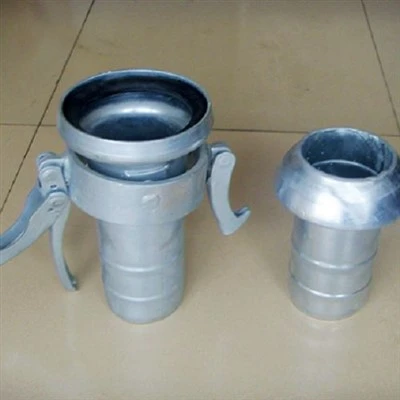
Next, you need to get the right lubricant. Here’s where most people mess up. Guillemin couplings work by having a male end with external threads and a quick-release locking lever, and a female end with internal threads that twist into place. The lubricant has to protect both the threads and the lever’s moving parts, and it has to be compatible with any fluid your coupling transfers. For general-purpose use—like transferring clean water, standard hydraulic oil, or non-corrosive slurry—our go-to is a lithium-based grease with a NLGI grade of 1 or 2. It’s thick enough to stay in place through heavy vibration and temperature swings, but not so thick that it gums up the lever. If you’re working in extreme cold (below 0°F/-18°C), switch to a synthetic polyurea grease—it won’t get stiff when temperatures drop. For high-heat applications (above 200°F/93°C), like transferring hot oil or steam, use a synthetic silicone-based lubricant that won’t break down under heat. And if you’re transferring food-grade materials? You absolutely need a food-safe lubricant, like NSF H1 rated grease, to avoid contamination. I can’t stress this enough: using a general automotive grease in a food processing plant is a fast track to a OSHA fine or a product recall.
Now, the actual process. I’ve watched so many guys slap a glob of grease on the threads and call it a day, and that’s not enough. It gets uneven, runs off when the coupling is under pressure, and doesn’t protect the small crevices on the locking lever. Let’s break this down step by step, the way I teach my customers over the phone and at our monthly on-site workshops.
Step 1: Prep the coupling first. You can’t lubricate a dirty coupling. Before you do anything, disconnect the coupling (if it’s connected) and take a rag or a stiff brush to scrub off any caked-on slurry, dirt, or old lubricant from the male threads, female bore, and locking lever. If there’s really tough grime, a quick rinse with water (and a small amount of dish soap, if it’s not a food-grade application) works, but make sure to dry it completely before moving on. Moisture mixed with old grease just makes a paste that clogs the threads.
Step 2: Lubricate the threads, but not too much. Take a small amount of your chosen lubricant—about the size of a pea for standard 2-inch couplings, a bit larger for larger models. Spread it evenly across the external threads of the male end, making sure to get into each groove, not just on the peaks. For the female end, add a thin coat of lubricant to the internal threads and a light layer on the inside of the coupling’s bore, where the two ends meet. Too much grease here will build up inside the coupling, contaminate your transferred fluid, and even cause leaks. I always tell customers: if you can see globs of grease sitting on the threads, you’ve used too much.
Step 3: Don’t forget the locking mechanism. This is the part that most people miss. The quick-release lever has a pivot point and a notch that locks into place to hold the coupling tight. If this part is dry, it will stick, making it impossible to disconnect without force. Take a tiny amount of lubricant—just enough to coat the pivot—and work the lever a few times to work the grease into the mechanism. For older couplings that are starting to seize, you can also add a drop of penetrating oil (like PB Blaster, not WD-40) to the lever’s pivot first, let it sit for 10 minutes, before adding the grease.
Step 4: Reconnect and work the coupling to distribute the lubricant. After you’ve lubricated both ends, twist the male end into the female end by hand until it’s finger-tight, then give it a quarter turn with a wrench to seat it. Now, open and close the locking lever a few times back and forth. This moves the lubricant into all the small gaps, between the lever and its housing, and along the threads. Then disconnect it and inspect the threads: you should see a thin, even layer of lubricant, not bare metal or thick globs. If it looks uneven, add a tiny bit more grease.
Step 5: Test it. After lubricating, reconnect the coupling and apply a low amount of pressure (just enough to confirm it’s sealing) to check for leaks. If it leaks, it’s likely you used too much grease, or you didn’t seat the threads properly. Disconnect, wipe off the excess, and re-seat it.
I’ve seen firsthand how skipping this process leads to costly downtime. A farmer I worked with last year was using a 6-inch Guillemin coupling to transfer irrigation water to his fields. He was a “just use it until it breaks” type, so he never lubricated the coupling. After three months of heavy use, the locking lever seized solid, and he had to replace the entire $120 coupling mid-season, right when he needed water for his corn. If he’d taken 5 minutes to lubricate it every 50 uses, that coupling would still be working for him.

Now, a few common mistakes to avoid. First, don’t use old, expired lubricant. Grease has a shelf life, usually two to five years depending on the type. If it’s past its expiration date, it can harden or separate, so it won’t provide proper protection. Second, never use lubricant that’s incompatible with your coupling’s material. Most Guillemin couplings are made of cast iron, steel, or aluminum, but some specialty couplings are stainless steel. Using a grease that’s not compatible with stainless can cause galvanic corrosion, which will weaken the coupling over time. Third, don’t over-tighten the coupling when you connect it. A lot of people crank it with a wrench until they can’t turn it, but that puts unnecessary stress on the threads and the locking mechanism. Finger-tight plus a quarter turn is all you need.
Safety Clamp If you’re unsure which lubricant is right for your specific coupling, or you have questions about the maintenance schedule for your application, I’m here to help. I’ve been in this industry for years, and I’ve worked with everything from small farm operations to large mining companies. I don’t just sell couplings—I help people keep their equipment running smoothly, so they don’t have to deal with costly failures. Whether you need replacement couplings, guidance on maintenance, or bulk supplies for a large project, feel free to reach out to connect for a procurement conversation. We can walk through your specific needs, recommend the right products, and make sure you have the support you need to keep your operations running without downtime.
References
- Fluid Power Society. “Guidelines for Maintenance of Quick-Disconnect Couplings.” Fluid Power Journal, vol. 18, no. 3, 2021, pp. 45-52.
- National Agricultural Contractors Association. “Bulk Fluid Transfer Equipment Maintenance Handbook.” NACA Publications, 2020, pp. 112-118.
- ISO 7241-2:2019. “Hydraulic fluid power—Couplings for general use—Part 2: Maintenance and operation.” International Organization for Standardization, 2019.
Suzhou Fuyikang Metal Industrial Co., Ltd.
As one of the most professional guillemin coupling manufacturers and suppliers in China, we have world-leading production equipment and strong manufacturing capabilities. We warmly welcome you to buy bulk high quality guillemin coupling for sale here from our factory.
Address: No.26.Mudong Rd,Mudu Town, Wuzhong Distric, Suzhou City,Jiangsu Province,China
E-mail: SZFYK@SZFUYIKANG-COUPLING.COM
WebSite: https://www.fyk-coupling.com/
